Mastering ERS in F1 24: How to Manage Battery for Faster Lap Times
Learn how to adapt ERS deployment from qualifying to race mode and across track conditions. This F1 24 ERS management guide explains battery strategy deltas, overtake button usage, and wet versus dry deployment priorities for consistent lap times.
Gameplay Strategy · EN · Updated · 11 min read

On this pageTap to expand
F1 24 introduced a significantly more manual energy recovery system compared to previous titles, forcing players to actively manage battery deployment and harvesting throughout every lap. This F1 24 ERS management guide explains how to adapt your battery strategy across session types, track characteristics, and weather conditions. The baseline challenge is balancing aggressive deployment for maximum speed against sustainable harvesting to avoid mid-stint energy deficits. Unlike F1 23's more automated approach, F1 24 requires you to understand when to deploy, when to harvest, and how to adjust your strategy based on whether you're chasing a qualifying hotlap or managing a 20-lap race stint.
Understanding the Overtake Button and MGU-K Deployment Modes
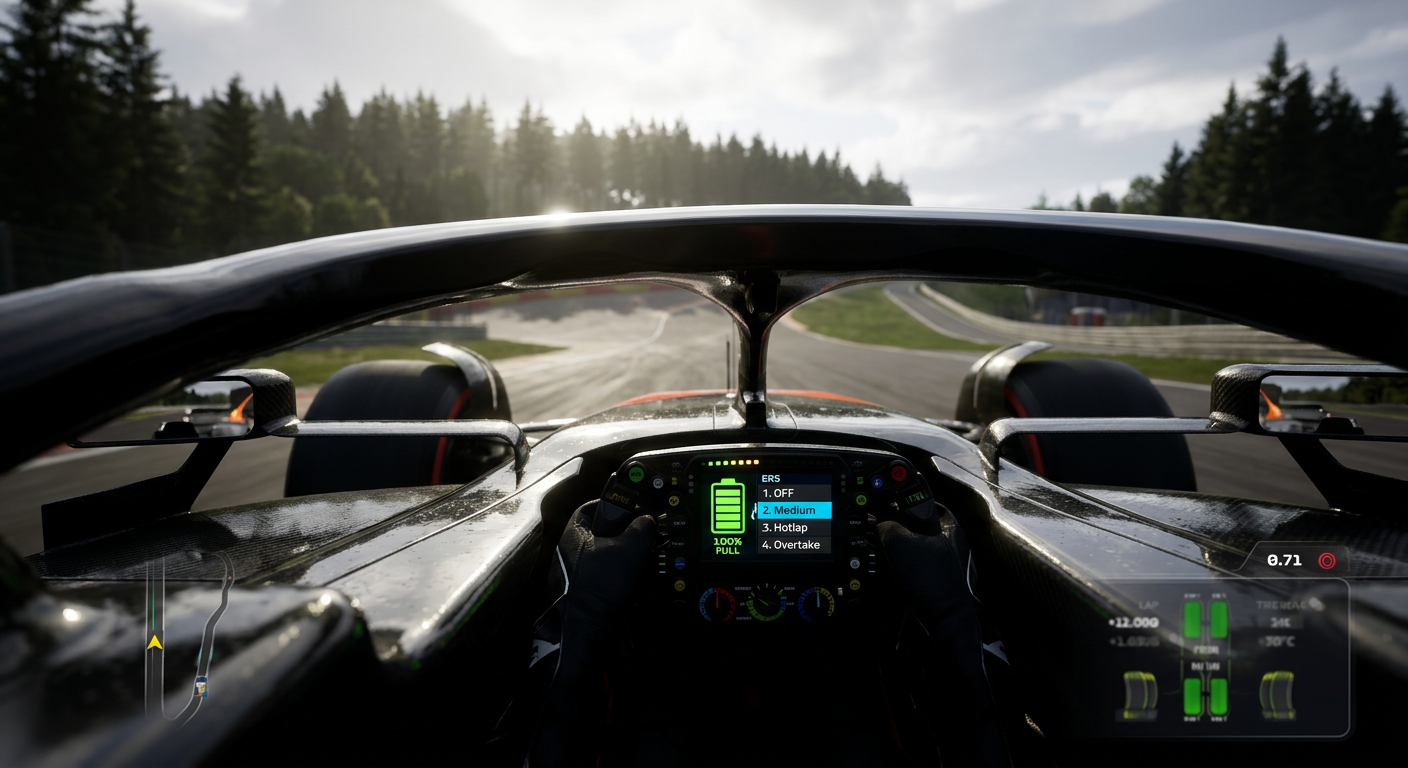
The F1 24 energy recovery system operates through three core deployment modes: None, Medium, and Overtake (also called Hotlap mode). Each mode controls how aggressively the MGU-K releases stored electrical energy to supplement the combustion engine. None mode preserves battery by deploying minimal energy, Medium provides balanced deployment for sustained pace, and Overtake unleashes maximum power for short bursts on straights and acceleration zones.
The overtake button strategy F1 24 players must master involves knowing when to hold versus tap the button. Holding the overtake button continuously drains your battery rapidly, often leaving you empty before completing a full lap. Instead, tap the button in short bursts during key acceleration zones—corner exits, long straights, and uphill sections where the extra power delivers measurable lap time gains. Between deployment windows, the MGU-K automatically harvests energy during braking zones, converting kinetic energy back into electrical charge for the next deployment opportunity.
💡Harvesting Maximization
Use engine braking at 100% to maximize energy recovery during every braking zone. This setting ensures the MGU-K captures the maximum possible charge without requiring you to brake earlier or harder than your racing line demands.
Baseline ERS Strategy: Qualifying vs Race Mode
Your qualifying baseline should prioritize aggressive ERS deployment in hotlap mode, using full battery charge across the lap to extract maximum single-lap pace. Deploy overtake mode on every major straight and key acceleration zone, accepting that you'll finish the lap with minimal battery remaining. The goal is outright speed, not sustainability. This F1 24 ERS management guide approach works because qualifying laps are isolated efforts with full battery recharge between attempts.
The race adaptation delta shifts priorities from maximum speed to consistent lap times without energy deficits. Reduce deployment frequency to avoid the common F1 24 battery drain fix scenario where you run empty for 15 laps after over-deploying early in the stint. Instead of deploying on every straight, target only the highest-value zones—typically the longest straights where ERS delivers the greatest time advantage. Between deployment laps, use Medium mode or None to allow the battery to recharge through harvesting.
The Belgium qualifying and race setups demonstrate how session type changes ERS priorities even when mechanical setup remains similar. Both configurations use 100% on-throttle differential and 100% engine braking, but the off-throttle differential changes from 25% in qualifying to 30% in race mode. This 5% increase provides more stable braking and consistent harvesting during race stints, supporting the longer-term battery management strategy required for multi-lap consistency.
Belgium — F1 24 Qualifying Setup
Mixed Controller setup optimized for single-lap pace at Circuit de Spa-Francorchamps with aggressive front wing and reduced off-throttle differential for sharp turn-in during qualifying hotlaps.
View Qualifying Setup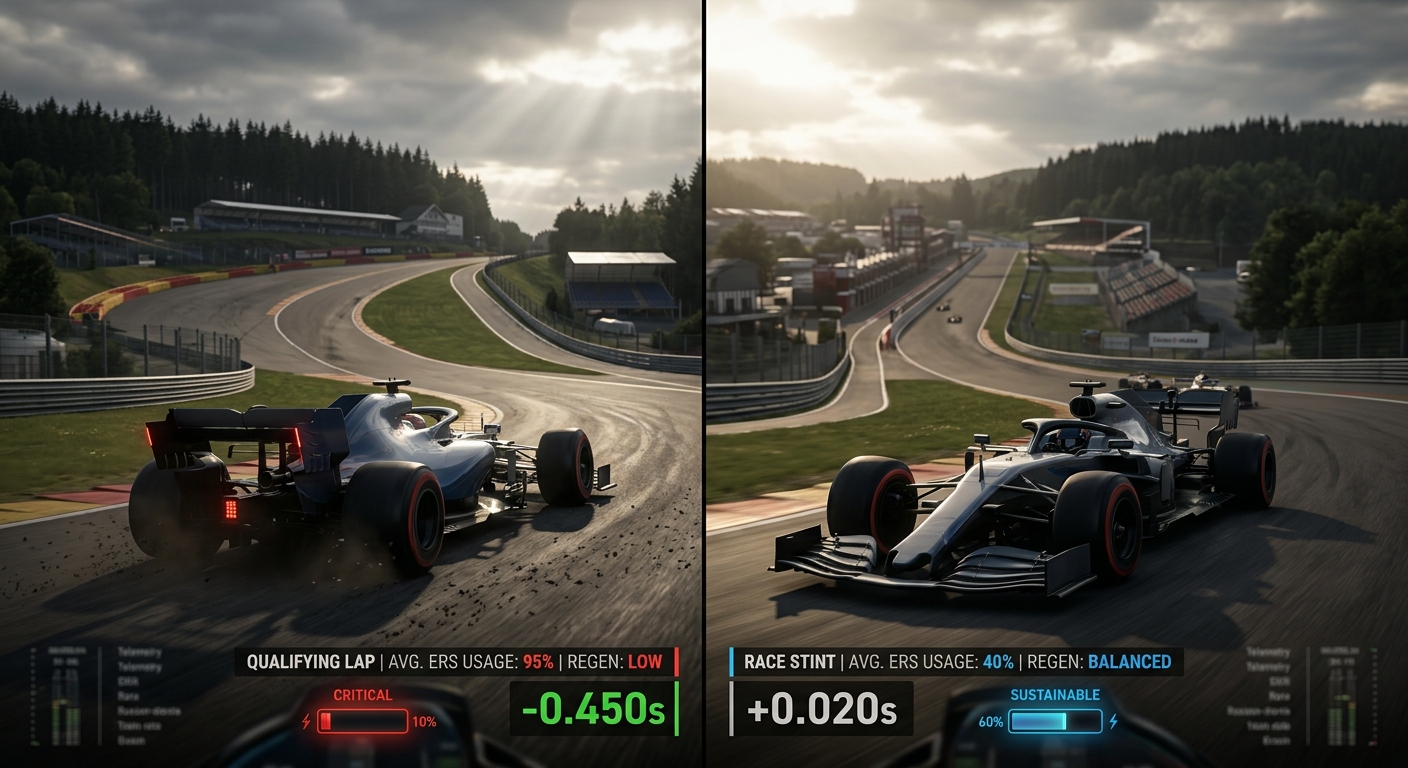
Adapting ERS Deployment Across Track Conditions
Track characteristics fundamentally alter where and when you should deploy ERS. High-speed circuits like Spa demand prioritization of long straights and uphill sections where electrical power supplements combustion engine output for maximum time gain. At Spa specifically, the Kemmel straight and the uphill run from Eau Rouge to Raidillon represent the highest-value deployment zones. Deploy overtake mode from La Source exit through the Kemmel straight, then harvest aggressively through Les Combes and Rivage before deploying again from Pouhon through Blanchimont.
Technical circuits with shorter straights and more emphasis on corner speed require a different approach. Shift deployment priority to corner exits where traction is critical, using ERS to compensate for slower corner speeds rather than sustaining deployment through long straights. The elevation changes at Spa create natural harvesting opportunities on downhill braking zones—the descent into Eau Rouge, the braking for Les Combes, and the Bus Stop chicane all allow aggressive harvesting without compromising your racing line.
The Spa race setup's minimal rear wing (0) and moderate front wing (2) prove that aerodynamic efficiency allows more aggressive ERS deployment without drag penalty. Low rear wing reduces drag on straights, meaning the ERS power translates directly into higher top speed rather than fighting aerodynamic resistance. Contrast this with high-downforce circuits where you must use ERS to compensate for slower corner speeds, deploying more frequently on exits and less on straights where drag limits the benefit.
Wet vs Dry ERS Adaptation: Managing Deployment on Slippery Surfaces
Wet conditions force a critical adaptation in how you deploy ERS to avoid wheelspin and maintain rear traction. Your dry baseline allows full overtake deployment immediately on corner exits without traction loss risk. The rear tires grip sufficiently to handle the combined power from combustion engine and MGU-K without breaking traction. In wet conditions, this same aggressive deployment causes instant rear wheelspin, destroying lap time and potentially spinning the car.
The wet adaptation delta requires reducing deployment intensity or delaying activation until the car is fully straightened. Instead of deploying at corner apex or early in the exit phase, wait until the steering wheel is centered and the car is stable before engaging overtake mode. The 100% on-throttle differential in both Spa setups helps stabilize rear traction by locking the differential under power, allowing slightly more aggressive ERS use even in mixed conditions compared to lower differential settings.
Wet conditions provide a harvesting advantage that partially compensates for reduced deployment opportunities. Heavier braking earlier in braking zones means more kinetic energy converted to electrical charge per lap. You'll brake 20-30 meters earlier for most corners in wet conditions, and that extended braking phase allows the MGU-K to harvest more aggressively. A tangible example: the Pouhon exit in dry conditions allows immediate full deployment as you unwind the steering. In wet conditions, delay deployment until the car rotates and you're tracking straight toward Fagnes, preventing the snap oversteer that occurs when combining steering input with excessive rear power.
Race Stint ERS Management: Avoiding Mid-Stint Battery Deficits
Race stint battery management requires rationing ERS across 15-20 laps instead of a single qualifying push. Your baseline race ERS strategy should deploy on overtaking opportunities and key straights while harvesting aggressively on every braking zone. The most common F1 24 battery drain fix mistake occurs when players over-deploy in the first 5 laps, running empty for the remainder of the stint and losing multiple tenths per lap to competitors managing their battery effectively.
Implement a lap-by-lap deployment cadence to maintain battery charge throughout the stint. Use full overtake deployment every 3-4 laps on your highest-value straight—at Spa, this means the Kemmel straight. On intermediate laps, use Medium mode for sustained pace without draining the battery, or None mode if you need to build charge for an upcoming overtaking opportunity. This rhythm ensures you always have battery available when you need it for defense or attack.
The race setup's higher off-throttle differential (30% versus 25% in qualifying) supports more stable braking and consistent harvesting. The increased differential locks the rear axle more under braking, reducing rear instability and allowing you to brake later and harder without losing the car. This stability translates directly into more effective harvesting because you can commit to aggressive braking without fear of rear lockup or rotation. At Spa, prioritize the Kemmel straight as your deployment zone in race mode, saving battery for overtakes rather than deploying on every acceleration zone as you would in qualifying.
Belgium — F1 24 Race Setup
Mixed Controller setup optimized for race stint consistency at Circuit de Spa-Francorchamps with balanced aerodynamics and increased off-throttle differential for stable harvesting.
View Race SetupComparison: Qualifying Hotlap vs Race Stint ERS Deployment at Spa
A qualifying hotlap at Spa uses overtake mode from La Source exit through Eau Rouge and Raidillon, deploys again on the entire Kemmel straight, harvests through Les Combes and Rivage, then deploys a final time from Pouhon through Blanchimont before harvesting into the Bus Stop chicane. This aggressive strategy uses 80-90% of available battery charge to extract maximum single-lap pace, accepting that you'll finish the lap nearly empty.
The race stint adaptation targets only 40-50% battery usage per lap for sustainability. Deploy overtake mode only on the Kemmel straight for the first 10 laps, using Medium or None mode everywhere else. Add the Pouhon-Blanchimont deployment only when defending position or attacking a car ahead, not as standard practice every lap. This conservative approach maintains battery charge throughout the stint, ensuring you always have energy available for critical moments.
Qualifying vs Race ERS Deployment Comparison at Spa
| Phase | Qualifying Strategy | Race Strategy | Battery Impact |
|---|---|---|---|
| La Source Exit | Full Overtake | Medium Mode | High vs Moderate |
| Kemmel Straight | Full Overtake | Full Overtake (Every 3-4 Laps) | High vs Controlled |
| Pouhon-Blanchimont | Full Overtake | Overtake Only When Attacking/Defending | High vs Situational |
| Lap Battery Usage | 80-90% | 40-50% | Single-Lap vs Sustainable |
The setup delta between qualifying and race configurations supports these different ERS strategies. The front wing increase from 2 in race trim to 4 in qualifying adds front-end stability, allowing more aggressive ERS deployment on corner exits without understeer. The car rotates more willingly with higher front downforce, meaning you can deploy power earlier in the exit phase without pushing wide. The off-throttle differential reduction from 30% in race to 25% in qualifying allows sharper turn-in when battery is being aggressively deployed on exits, as the looser rear end helps rotation when you're carrying more speed from ERS-assisted acceleration.
Common ERS Mistakes and How to Fix Them
The first critical mistake is holding the overtake button through entire straights instead of tapping for controlled bursts. Continuous deployment drains your battery in seconds, leaving you with no energy for the remainder of the lap or stint. Fix this by pulsing deployment—tap the overtake button for 1-2 seconds, release, then tap again. This rhythm preserves battery while still delivering meaningful power boosts in high-value zones.
The second mistake involves ignoring harvesting opportunities by coasting instead of braking. Players often lift early and coast into corners to avoid lockups, but this approach sacrifices energy recovery. Fix this by using the 100% engine braking setting present in both Spa setups to maximize recovery on every braking zone. Brake later and harder, trusting the engine braking to capture energy while the brake bias and ABS handle stopping power.
- Mistake 3: Deploying ERS in low-speed corners where traction is limited. Fix by reserving deployment for high-speed zones and straights where the car can handle the extra power without wheelspin.
- Mistake 4: Running identical ERS strategy in qualifying and race. Fix by reducing deployment frequency and intensity for race stints, targeting 40-50% battery usage per lap instead of 80-90%.
- Mistake 5: Failing to adapt deployment timing in wet conditions. Fix by delaying overtake activation until the car is straightened to prevent rear wheelspin and snap oversteer.
💡ERS Management Checklist
Before every session, identify your three highest-value deployment zones based on track layout. Prioritize long straights and uphill sections in dry conditions, corner exits in wet conditions. Harvest on every braking zone using 100% engine braking. Adapt deployment intensity to session type—aggressive in qualifying, conservative in race stints.
Frequently Asked Questions
FAQ
How do I know if I'm over-deploying ERS in race stints?
Monitor your battery level at lap 5 and lap 10. If you're below 30% charge by lap 5, you're over-deploying. Target 60-70% remaining at lap 5 and 40-50% at lap 10 for sustainable pace throughout a 20-lap stint.
Should I use overtake mode on every corner exit in qualifying?
No. Prioritize high-speed corners and long straights where ERS delivers maximum time gain. Low-speed corners often lack the traction to handle full deployment, causing wheelspin that costs more time than the ERS gains. Focus on exits leading to straights and uphill sections.
Does MGU-K setting affect how much energy I harvest during braking?
Yes. Higher MGU-K deployment modes harvest more aggressively during braking zones. However, the primary harvesting control is engine braking percentage. Set engine braking to 100% to maximize energy recovery on every braking zone regardless of your deployment mode.
How should I adapt ERS deployment when defending position in a race?
Reserve full overtake deployment for the longest straight on your circuit where the attacker is most likely to attempt a pass. Use Medium mode everywhere else to maintain battery charge. This ensures you have maximum power available at the critical defensive moment without running empty mid-stint.
Keep exploring
Continue from this guide with related hubs and circuit pages.
Related setups
Apply the knowledge from this guide with a ready-made setup.