How To Adapt a Dry Setup for Rain in F1 25 | Ultimate Wet Weather Guide
Learn how to transform your dry Silverstone baseline into a competitive wet weather setup in F1 25. This F1 25 wet weather setup guide walks through priority deltas, before-and-after comparisons, and validation steps to keep you on track when the rain arrives.
Setup & Performance · EN · Updated · 9 min read

On this pageTap to expand
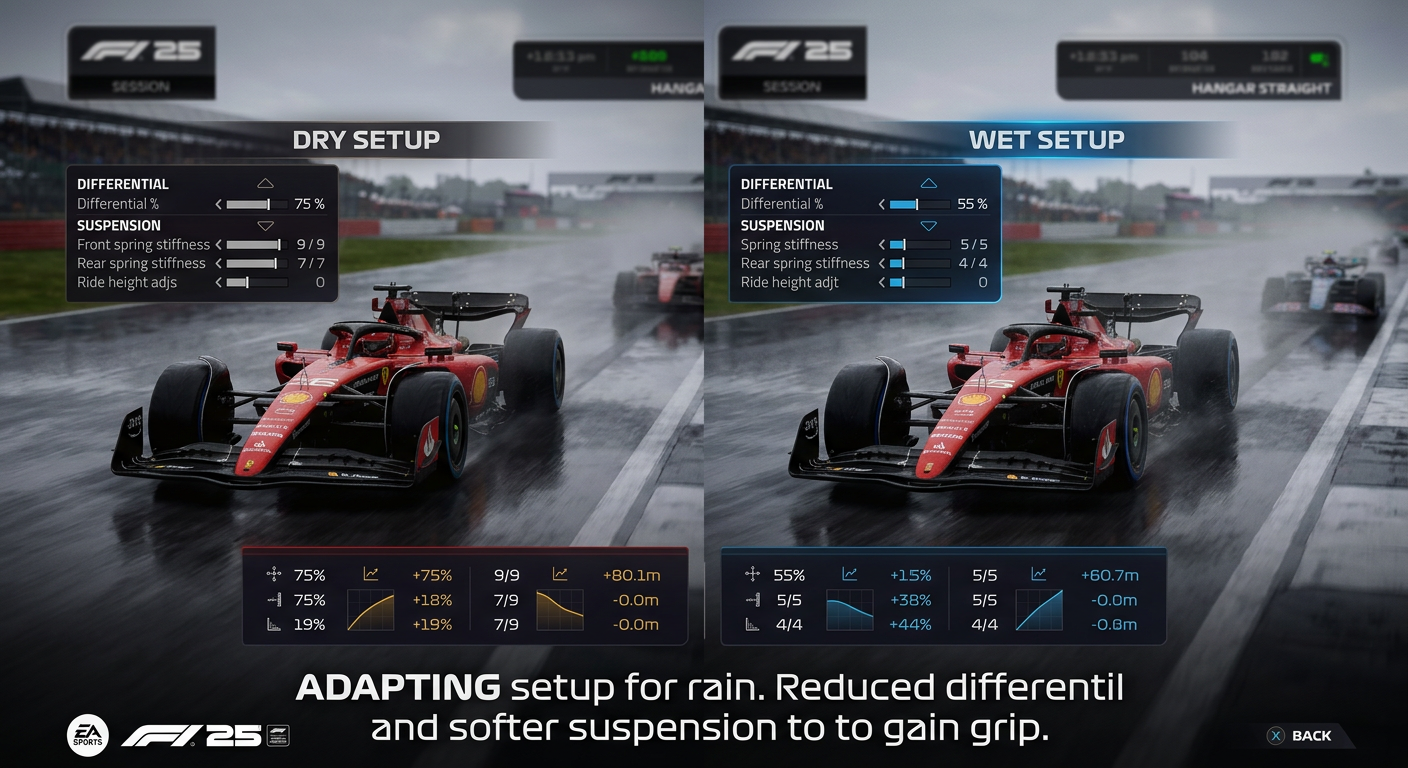
When the rain arrives at Silverstone Circuit, your dry setup becomes a liability. This F1 25 wet weather setup guide shows you how to adapt an existing baseline rather than rebuild from scratch. You will learn which parameters to change first, how much to adjust them, and what on-track symptoms confirm the adaptation is working. The focus is on deltas and priorities, not rewriting every value.
Start from the F1 25 at Silverstone Circuit baseline
Before making any changes, identify your dry baseline. For this guide, we use the Great Britain Race Setup as the reference point: Front Wing 11, Rear Wing 0, On Throttle Differential 100%, Off Throttle Differential 25%, Front Camber -3.50°, and Rear Camber -2.00°. This setup is optimized for dry mixed conditions on controller, balancing high-speed stability through Copse and Maggots-Becketts with rotation in slower corners.
When rain begins, the track surface loses grip and standing water creates aquaplaning risk. The dry baseline's low ride height and stiff suspension will cause the car to skip over puddles and lose mechanical grip. Your goal is to adapt the setup to restore predictability and traction without abandoning the core balance that worked in the dry.
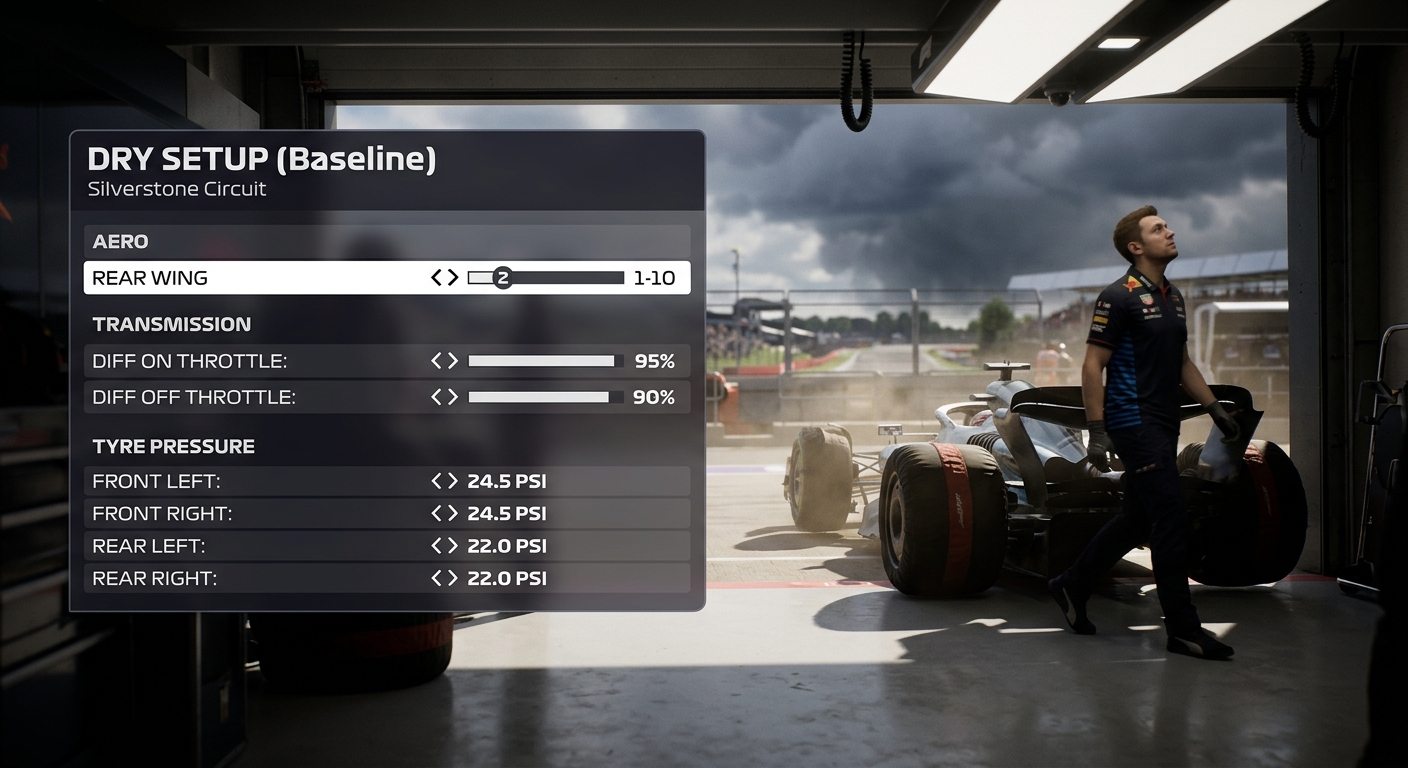
💡Keep your baseline file
Save your dry setup under a distinct name before making wet weather changes. This lets you revert quickly if conditions dry out during a dynamic weather session or if you need to compare lap times between configurations.
What changes when conditions shift
The F1 25 tire model punishes aquaplaning more severely than F1 24, so ride height becomes your first priority. Raise both front and rear ride height by two to three clicks to lift the floor above standing water. This prevents the sudden loss of downforce that causes mid-corner snaps. You will feel the car settle more predictably on entry and carry speed through puddles without skipping.
Next, soften the suspension and anti-roll bars. Reduce front and rear anti-roll bar stiffness by one to two steps to allow the tire contact patch to follow the road surface. Softer suspension improves mechanical grip when aero grip is reduced by rain. The car will roll more in high-speed corners like Copse, but the trade-off is better traction on corner exit and fewer lock-ups under braking.
- Raise ride height by two to three clicks front and rear to prevent aquaplaning and maintain floor downforce over standing water.
- Soften anti-roll bars by one to two steps to improve mechanical grip and tire contact patch compliance on a slippery surface.
- Shift brake bias one to two percent rearward to reduce front lock-up risk and stabilize the car under heavy braking into corners.
- Reduce on-throttle differential by five to ten percent to allow the inside rear wheel to spin slightly, improving rotation on corner exit.
- Increase tire pressures by 0.2 to 0.4 PSI to compensate for cooler track temperatures and maintain optimal contact patch shape.
Brake bias adjustment is critical. Move bias one to two percent rearward to reduce front lock-up risk. In the wet, front tires lose grip earlier, and a forward bias will cause the fronts to lock before the rears contribute meaningful stopping power. You should feel more stable braking into Brooklands and Luffield, with less steering correction needed to keep the car straight.
Finally, reduce the on-throttle differential by five to ten percent. A locked differential in the wet causes understeer on exit because the inside rear wheel cannot slip. Allowing slight inside wheel spin improves rotation and helps the car turn through slower corners like Village and The Loop. The car will feel more responsive to throttle input, but avoid over-reducing the differential or you will lose traction on high-speed exits.
Use the setup evidence as a before-and-after comparison
To make the adaptation tangible, compare the Great Britain Race Setup with the Great Britain Qualifying Setup. Both share the same aerodynamic values—Front Wing 11 and Rear Wing 0—but the qualifying setup reduces Off Throttle Differential from 25% to 20%. This five percent delta improves rotation on entry, which is exactly the direction you want to move when adapting for wet conditions.
In the wet, start with the race setup's 25% off-throttle differential and reduce it to 20% or even 15% depending on how much standing water is present. The lower value allows the rear to rotate more freely under braking and coast phases, helping the car turn into corners like Stowe and Club without understeering wide. You will notice the rear feels more mobile, but the car remains stable if you have already softened the anti-roll bars and raised the ride height.
Great Britain — F1 25 Race Setup
Use this mixed controller setup for Silverstone Circuit as your dry baseline before adapting for wet weather. Front Wing 11, Rear Wing 0, and balanced differential settings provide a stable starting point.
View Race SetupDry baseline vs wet adaptation deltas for Silverstone Circuit
| Parameter | Dry Baseline | Wet Adaptation | Delta |
|---|---|---|---|
| Ride Height (Front/Rear) | Baseline | +2 to +3 clicks | Higher to prevent aquaplaning |
| Anti-Roll Bars (Front/Rear) | Baseline | -1 to -2 steps | Softer for mechanical grip |
| Brake Bias | Baseline | +1% to +2% rear | Reduce front lock-up risk |
| On Throttle Differential | 100% | 90% to 95% | Allow inside wheel slip |
| Off Throttle Differential | 25% | 15% to 20% | Improve rotation on entry |
The camber settings—Front -3.50° and Rear -2.00°—can remain unchanged for light rain or intermediate tire conditions. If you switch to full wet tires, consider reducing front camber to -3.00° to increase the contact patch and improve straight-line braking stability. The rear camber can stay at -2.00° because the rear tires generate less lateral load in the wet and do not benefit as much from additional negative camber.
Great Britain — F1 25 Qualifying Setup
Compare this qualifying setup's 20% off-throttle differential with the race baseline to understand how small deltas improve rotation. Apply the same logic when adapting for wet weather.
View Qualifying SetupValidation loop and next adjustments
After making the initial changes, run a three-lap validation stint. Focus on corner entry stability, mid-corner grip, and exit traction. If the car still understeers on entry into Brooklands or Luffield, reduce the off-throttle differential by another five percent. If the rear feels unstable on exit from Copse or Maggots, increase the on-throttle differential by five percent to lock the rear axle slightly more.
Check tire temperatures after the stint. In the wet, tire temperatures drop significantly, and you may see front or rear temps below the optimal window. If fronts are too cold, reduce front ride height by one click to increase load and generate heat. If rears are too cold, increase rear anti-roll bar stiffness by one step to transfer more load through the rear axle during cornering.
💡Timing the crossover window
Monitor the weather radar and track surface water level. Pit for intermediates when the racing line begins to dry but standing water remains off-line. Pit for full wets only when the entire track is soaked and intermediates overheat within two laps. Delaying the switch by one lap can cost five to ten seconds in a race.
If the adaptation still feels wrong, revert to the dry baseline and make smaller incremental changes. The most common mistake is over-softening the suspension or raising ride height too much, which causes the car to wallow and lose responsiveness. Start with the minimum recommended deltas and add more only if the on-track symptoms persist.
FAQ
Should I change aerodynamics when adapting for wet weather?
In most cases, keep your dry aero settings unchanged. The Front Wing 11 and Rear Wing 0 configuration from the Silverstone baseline provides enough downforce for wet conditions. Only increase rear wing if you experience severe oversteer on high-speed entries like Copse, but this is rare if you have already softened the suspension and raised ride height.
How do I know if I have raised ride height too much?
If the car feels floaty and unresponsive in medium-speed corners like Village or The Loop, you have raised ride height too far. The floor loses downforce when too high, and the car will not turn in crisply. Reduce ride height by one click at a time until the car feels planted again without aquaplaning.
What is the difference between intermediate and full wet tire pressures?
Intermediate tires require slightly higher pressures—typically 0.2 to 0.4 PSI above your dry baseline—to maintain contact patch shape on a damp but drying track. Full wet tires can run at or slightly below dry pressures because the deeper tread generates more heat and the cooler track temperature reduces thermal expansion.
Can I use the same wet setup for all tracks?
No. High-speed tracks like Silverstone require more ride height to prevent aquaplaning at 180 mph through Copse, while slower tracks like Monaco can run lower ride height because speeds are lower and standing water is less dangerous. Always start from your dry baseline for each track and apply the same delta logic rather than copying a wet setup from another circuit.
This F1 25 wet weather setup guide gives you a repeatable process to adapt any dry baseline when rain arrives. Focus on ride height, suspension stiffness, brake bias, and differential deltas first. Validate the changes over a short stint, then refine based on tire temperatures and on-track feel. With practice, you will adapt faster and maintain competitive pace even in heavy rain.
Keep exploring
Continue from this guide with related hubs and circuit pages.
Related setups
Apply the knowledge from this guide with a ready-made setup.